
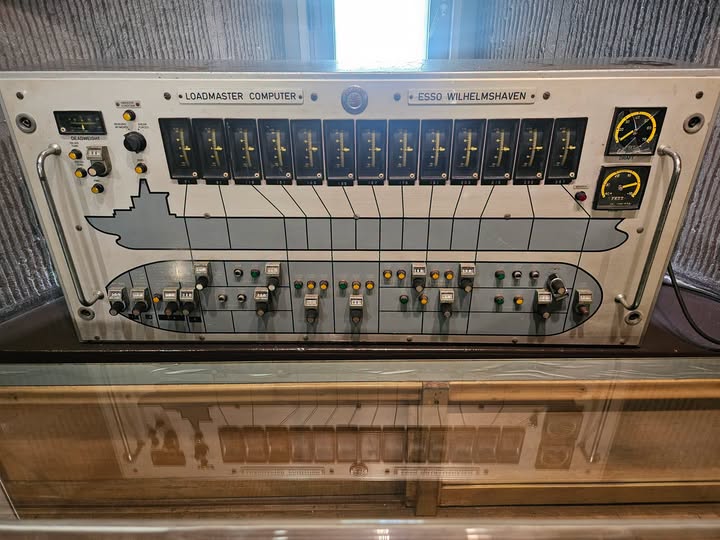
The mechanical ship loading computer that used actual physical scale weights is the Ralston Stability and Trim Indicator. Invented in the early 20th century by Ralston, this entirely analog, gravity-based computer allowed ship officers to physically model a vessel’s center of gravity, balance, trim, and metacentric height (GM) using movable brass or white metal slot-weights.
Design and Components. The device was a self-contained mechanical calculator housed in a premium mahogany or wooden case containing specialized drawers for storing the precision weights. The Etched Hull Plate: The core of the device is a duralumin or aluminum base plate precision-engraved with the detailed structural profile, cross-sections, holds, and tank compartments of that specific ship.
The Balance Frame: The engraved metal plate is set into a heavy brass frame mounted on a system of directional knife-edge suspension pivots.Proportional Scale Weights: Ship officers were provided with sets of small, calibrated metal weights. Each weight represented a specific cargo tonnage (e.g., 50, 100, or 500 tons).
How It Operated: Instead of typing data or turning electrical dials, the chief mate calculated stability by physically loading a miniature version of the ship:
Setting the Lightship: The balance plate itself was pre-weighted and calibrated to perfectly represent the ship’s empty “lightship” center of gravity and displacement.
Placing the Weights: The operator would look at the physical cargo manifest and place the corresponding scale weights into the engraved slots or trays representing the specific cargo holds, deep tanks, and double-bottom ballast tanks.
Testing Longitudinal Trim: To find the ship’s trim (forward and aft drafts), the operator balanced the mechanism on its longitudinal knife-edge pivot. By adjusting a mechanical vernier calculating screw on the top of the frame, they could bring the plate to a perfect horizontal balance, reading the resulting trim directly off a graduated indicator scale.
Testing Transverse Stability (GM): To calculate the vital metacentric height (GM) and check for list, the instrument was switched to balance on its athwartship (transverse) suspension points. A built-in pointer mechanism and curves engraved directly onto the metal plate indicated whether the current weight configuration kept the ship safely stable or dangerously top-heavy.
Historical significance: Before the advent of digital loading software, the Ralston Indicator was considered a marvel of engineering. It removed the risk of human mathematical error from manual hydrostatic calculations, transforming complex naval architecture formulas into a straightforward, visual, tactile process of mechanical balance. If you are researching a particular ship that utilized a Ralston block, or require details on how early electromechanical systems eventually phased out these physical weight balances.
Special thanks to Leo Bosner for the information.